The six noble gases are found in group 18 of the periodic table. These elements were considered to be inert gases until the 1960’s, because their oxidation number of 0 prevents the noble gases from forming compounds readily. All noble gases have the maximum number of electrons possible in their outer shell (2 for Helium, 8 for all others), making them stable. They are generally chemically inert. This means that they do not react with other elements because they already have the desired eight total s and p electrons in their outermost (highest) energy level. The elements in this group are helium, neon, argon, krypton, xenon, and radon. They are monatomic gases. These gases were not discovered until the last five years of the 1800s. They are extremely rare in nature, and none was known until helium was discovered to exist on the sun. In fact, the name of the element helium was derived from the Greek word Helios, used to refer to the sun.
The Noble Gases are:

- Helium (He)
- Neon (Ne)
- Argon (Ar)
- Krypton (Kr)
- Xenon (Xe)
- Radon (Rn)
Helium (He)

Name: Helium
Symbol: He
Atomic Number: 2
Atomic Mass: 4.002602 amu
Melting Point: -272.0 °C
Boiling Point: -268.6 °C
Number of Protons/Electrons: 2
Number of Neutrons: 2
Classification: Noble Gases
Crystal Structure: Hexagonal
Density @ 293 K: 0.1785 g/cm3
Color: colorless
Neon (Ne)
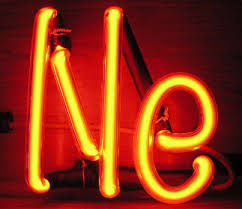
Name: Neon
Symbol: Ne
Atomic Number: 10
Atomic Mass: 20.1797 amu
Melting Point: -248.6 °C
Boiling Point: -246.1 °C
Number of Protons/Electrons: 10
Number of Neutrons: 10
Classification: Noble Gases
Crystal Structure: Cubic
Density @ 293 K: 0.901 g/cm3
Color: colorless
 Chemistry